

Official White Tash Haggis Toy
November 7, 2026Professor McDougal MacDougal
Badenoch Upland Research Station, Kingussie
Abstract. The continued appearance of the wild haggis in Scottish accounts raises a question which zoology has not settled to everyone’s satisfaction: what, precisely, survives when an animal remains unverified but its witnesses do not disappear? This note distinguishes the demonstrable existence of a tradition from the uncertain existence of its supposed subject, and sets out three claims that are too easily confused. Comparisons with fairy encounters, the Loch Ness Monster and Bigfoot suggest that testimony deserves to be recorded without being mistaken for a specimen, and that place-names preserve a further kind of evidence that is neither. The haggis may or may not be available for examination; the accounts of it are undeniably available, though their meaning remains contested.
Keywords: wild haggis; testimony; folklore; cryptozoology; place-names; uncertainty
The Creature and Its Witnesses
The wild haggis occupies an awkward position in Scottish natural history. Its range has been described with some confidence, its habits with greater confidence still, and its existence with rather less. Survey records describe an extensive tradition of creatures encountered in mountains, glens and moorland, while acknowledging that no verified specimen has been presented to scientific scrutiny. One cannot reasonably treat a report as a preserved skeleton. Equally, the absence of the skeleton does not make the report cease to exist.
The point is not that centuries of telling must convert a legend into an animal. Repetition can transmit an observation, but it can also transmit a good story. The more serious question is what lies behind the persistence: occasional unfamiliar animals, ambiguous glimpses, inherited expectation, deliberate invention, or some mixture not yet properly separated. Zoology is entitled to ask for an identifiable organism. Folklore is entitled to insist that the people who report one are themselves part of the evidence.
An Important Distinction
Three claims are too easily confused (Table 1; Figure 1). First, people tell stories about the haggis; this is established. Second, some narrators describe encounters as if they were experiences rather than recitations; this is a claim about testimony, which can be investigated. Third, those encounters establish a previously unrecognised animal; that conclusion does not follow without independent corroboration. An accumulation of accounts may justify further attention, but their number alone cannot determine whether witnesses encountered the same creature, different ordinary animals, or a shared expectation.
| Claim | Kind of evidence | What would establish it | Present status |
|---|---|---|---|
| People tell stories about the haggis | Recorded narratives, place-names | The record itself | Established |
| Some narrators describe encounters as experiences | Testimony | Dated, first-hand accounts made before comparison with familiar stories | Open to investigation |
| The encounters establish an unrecognised animal | Specimen, trace or independent corroboration | An identifiable organism examined by others | Not established |
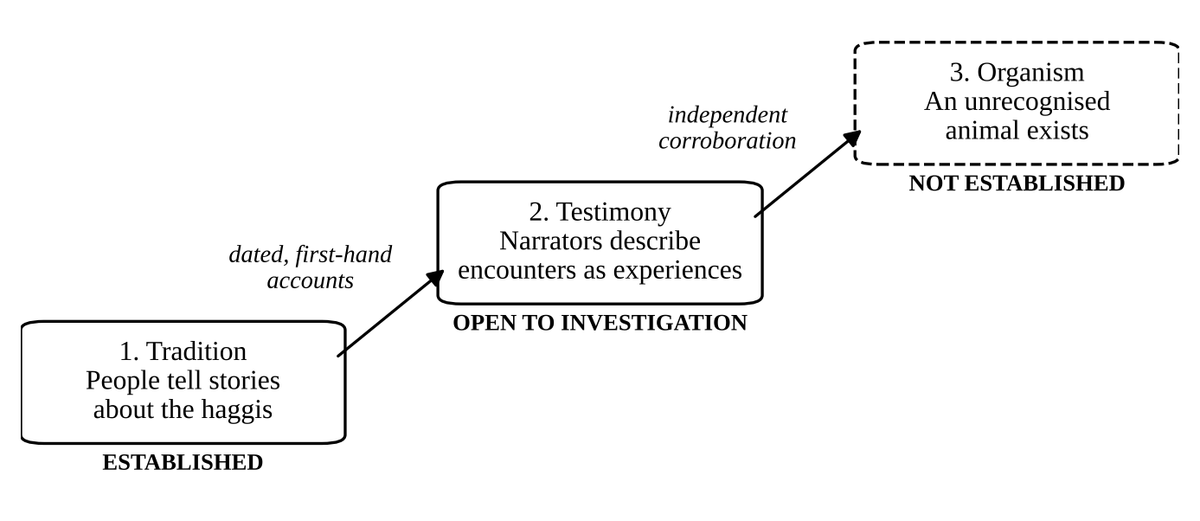
The three claims as successive levels of evidence, with the condition required to move from one to the next
The distinction preserves the witness without granting the witness an infallible eye. A crofter who reports movement among the heather may faithfully describe what was perceived while being uncertain what produced it. The name “haggis” is sometimes the conclusion, rather than the observation. This is not an insult to the crofter. It is the predicament of everyone who has seen something unexpected in poor light, including naturalists. The route from what a witness perceives to what is reported is shown in Figure 2.
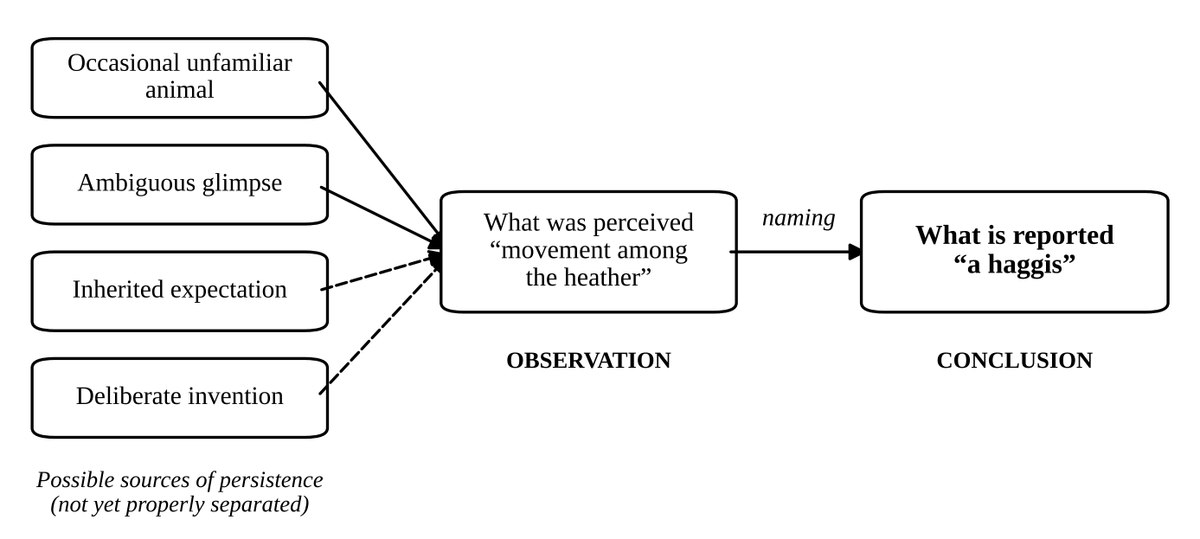
From possible sources of persistence to a reported haggis: observation and conclusion distinguished
Relatives in the Literature of the Unconfirmed
Fairy traditions offer a useful comparison because their accounts persist across places and generations without becoming an ordinary zoological category. Folklorists study these narratives as reports of experience as well as expressions of communal belief; the distinction between what happened to a witness and how a culture describes it is central to that enquiry (Harte, 2024). The witness may be certain of the encounter while its explanation remains open.
Loch Ness supplies a different lesson. A substantial programme of environmental-DNA sampling found no support for a prehistoric reptile in the loch, although it identified abundant eel DNA; it did not identify the source of every reported sighting (University of Otago, 2019). Scientific investigation can narrow possibilities without furnishing an answer for each witness. Bigfoot traditions, likewise, demonstrate that an extensive record of reported encounters and disputed traces is not identical with a verified animal. The quantity of testimony matters as a historical fact; its zoological force depends on the quality and independence of particular observations.
The haggis thus has respectable company, though not necessarily in the taxonomic sense. Fairies remain securely within folklore; Nessie remains conspicuously elusive; Bigfoot has acquired a remarkable capacity to avoid decisive identification. All three remind us that public conviction, personal experience and biological verification are different kinds of claim (Figure 3). The haggis adds the further inconvenience that people are particularly unwilling to be questioned after they have already explained its legs.
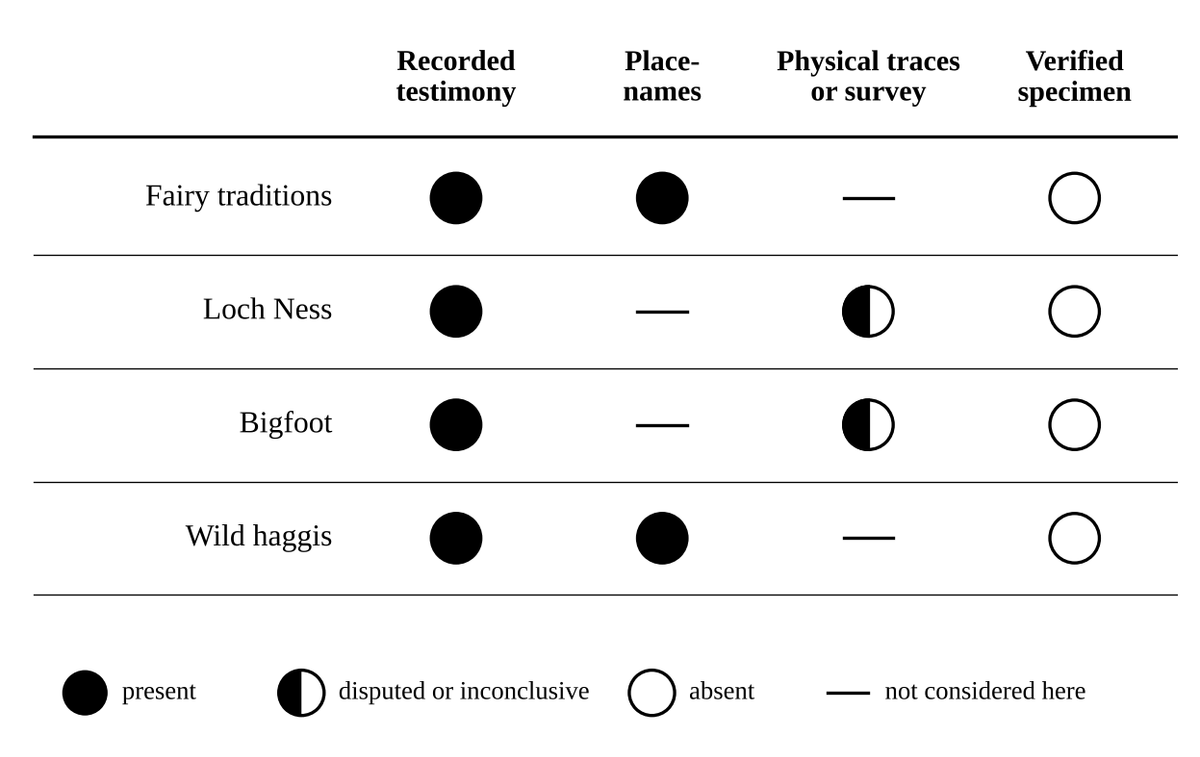
Classes of evidence recorded for four unconfirmed traditions, as discussed in this note
The Evidence of the Landscape
A third kind of record lies between the story and the specimen. Harte (2024) gathers the place-names in which the English landscape remembers its supernatural visitors, and shows that a name may preserve a belief about a place long after any account of an encounter has been lost. Scotland offers the haggis an equivalent. Haggis Knowe, a small outcrop of lava beneath Arthur’s Seat in Edinburgh, is held by local tradition to be where the haggis took refuge from hunting, and the terraces on its slopes, commonly taken for ancient cultivation, are attributed to the animals running around the hill (Historic Environment Scotland, 2017). The same account then warns that this version was devised to mislead visitors, and directs the reader instead to Schiehallion. A place-name is therefore good evidence that a belief was held at a place, and poor evidence of what the believers saw. The naturalist who records it should record both its form and its disclaimers, since the second may prove as instructive as the first.
What May Properly Be Concluded
A responsible account should neither certify the creature nor dismiss the witnesses by reflex. It should retain dates, places, conditions of observation, descriptions made before comparison with familiar stories, and any physical traces independently examined. Where accounts repeat one another, the repetition should be recognised; where they differ, the differences should be preserved. Such records establish the history of an unresolved claim even if they never establish a new species.
That something exists is therefore defensible only with care. A durable body of testimony exists. Experiences that witnesses interpret as encounters exist. Whether a particular wild animal stands behind them remains unsettled. The reality of the encounter, as lived by its witness, is not always the same question as the biological identity of what was encountered.
The Scottish hills are generous with mist, distance and mistaken scale, and ungenerous with clear photographs. For the present, the haggis occupies the narrow territory between what has been reported and what can be shown. The naturalist may decline to certify it; the witness may decline to withdraw it. Both positions can be recorded without forcing the mountain to arbitrate. If the animal wishes to settle the matter, a daytime appearance beside a graduated measuring rod would be appreciated.
References
Harte, J. (2024). Fairy encounters in medieval England: Landscape, folklore and the supernatural. University of Exeter Press.
Historic Environment Scotland. (2017, January 23). The legend of Haggis Knowe.
https://blog.historicenvironment.scot/2017/01/legend-haggis-knowe/
University of Otago. (2019, September 5). First eDNA study of Loch Ness points to something fishy.
https://www.otago.ac.nz/about/news/newsroom/first-edna-study-of-loch-ness-points-to-something-fishy


