

Haggii. s. hortensis
The Common Garden Haggis
Every wild haggis spotter needs somewhere to begin. For many, the search starts just beyond the back door.
A field guide for curious eyes and patient spotters.
More about
The Garden Haggis
The Common Garden Haggis (Haggii s. hortensis) occupies an unusual position within Scotland's haggis population. While wild varieties are generally associated with mountains, forests and isolated island environments, the Garden Haggis inhabits a landscape far closer to people: lawns, hedgerows, vegetable plots, old walls and the sheltered ground around houses.
This association with cultivated land is central to understanding the species. The Garden Haggis does not simply occupy a smaller version of a wild habitat. Its immediate environment is fragmented, frequently disturbed and extraordinarily varied at ground level. A hedge may provide cover, a compost heap warmth and food, while the exposed strip of lawn between them may represent a surprisingly significant journey for an animal of such modest dimensions.
Morphology
A body formed for life close to the ground
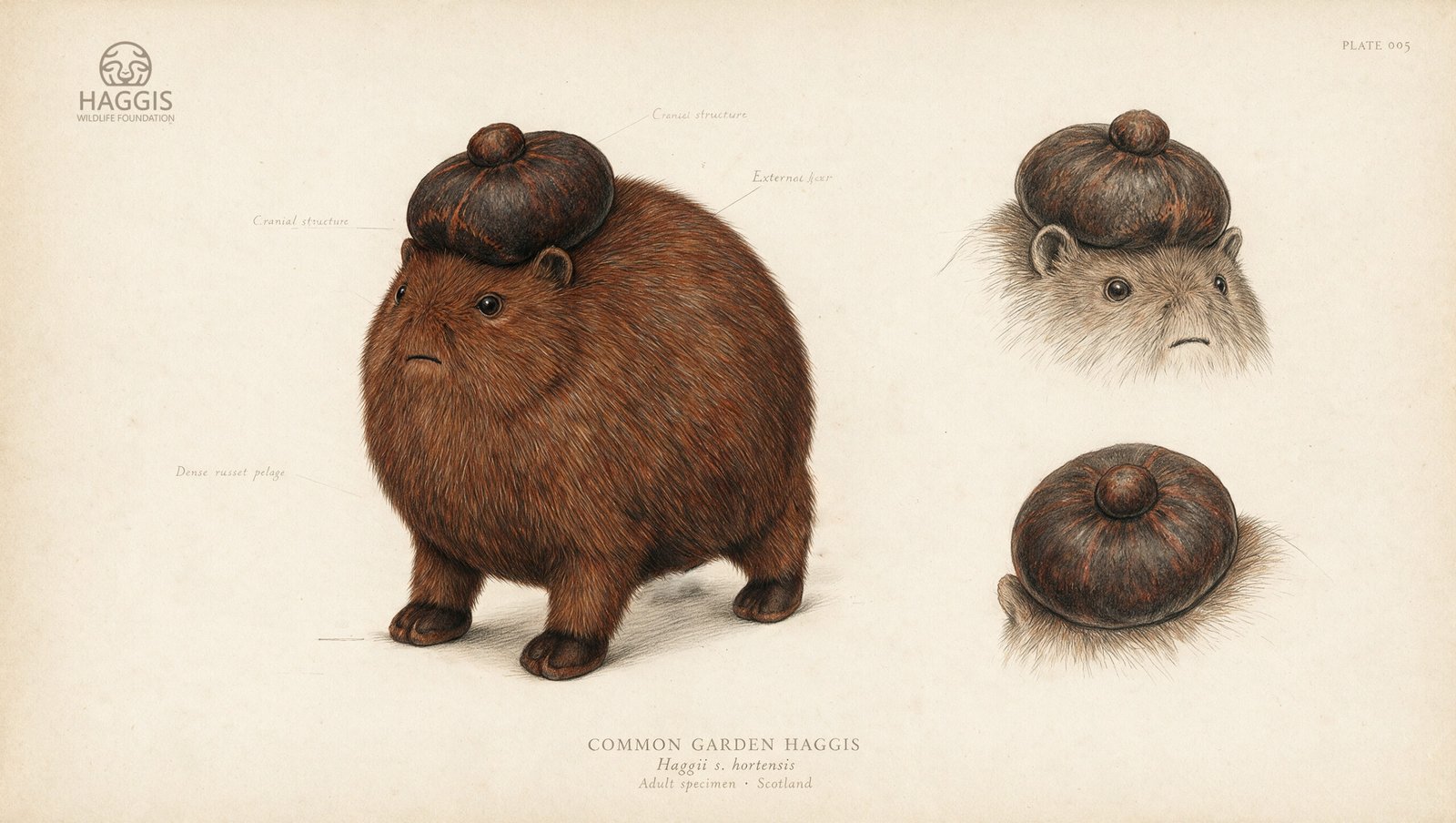
The most conspicuous characteristic of the Garden Haggis is its shape. The body is compact and approximately spherical, covered by dense russet-brown fur. Its limbs are short and robust, placing the animal close to the ground and producing a low centre of gravity. Although these proportions can appear cumbersome, they are well suited to movement beneath shrubs and through the dense lower vegetation typical of mature gardens.
The coat itself is important. Brown and reddish tones closely resemble damp soil, bark and decomposing leaves, particularly during autumn. Rather than relying upon conspicuous speed over long distances, the Garden Haggis appears adapted to short movements between areas of cover. Once stationary, its rounded outline and subdued colouring can become unexpectedly difficult to separate from the surrounding vegetation.
The cranial structure
Perhaps the most distinctive feature of H. s. hortensis is the dark structure situated above the head. Superficially it resembles a traditional Scottish bonnet, but its appearance suggests that it forms part of the animal's external anatomy. Dark radial markings extend across its surface towards a raised central node. The precise function of this structure has not been established.
Several possibilities can be considered from its visible form alone. Dense material in this position might provide insulation, particularly during cold or damp conditions. Its dark colour could also assist concealment when the animal is resting beneath vegetation. A role in communication between individuals is possible, but cannot be established from the available material. For now, it remains one of the species' most recognisable and least understood characteristics.
Habitat & Ecology
The garden as an ecological landscape
The Garden Haggis is principally associated with domestic gardens, cultivated ground and vegetated margins around human settlement. Within these places, structural variety appears particularly important. Hedgerows, established shrubs, stone boundaries, sheds, compost heaps and accumulations of leaves create sheltered spaces through which an animal can move without remaining exposed for long.
This changes the scale at which its environment must be considered. Features that appear trivial from a human perspective can form substantial elements of haggis habitat. A narrow opening beneath a fence may function as a movement corridor. The protected ground beneath a shed can become a refuge. A compost heap combines shelter with warmth and possible feeding opportunities. Even the boundary between a lawn and a densely planted border creates two sharply different conditions within a distance of only a few centimetres.
For the Garden Haggis, a domestic garden is not a small habitat. It is an entire landscape, divided by cover, exposed ground, feeding places and narrow routes of retreat.
Activity appears to be concentrated around dawn and dusk, indicating a predominantly crepuscular pattern. These periods provide reduced light while still allowing movement and foraging. Overcast conditions may extend useful periods of activity, particularly where dense vegetation already provides substantial concealment.
Seasonal change is also likely to alter how the species uses its surroundings. During autumn, fallen fruit, seeds, fungi and decaying vegetation become more abundant, while leaf litter increases the amount of available cover. Increased feeding at this time may also assist individuals in accumulating reserves before lower winter temperatures reduce both food availability and opportunities for activity.
Behaviour
Foraging, concealment and a quiet social life
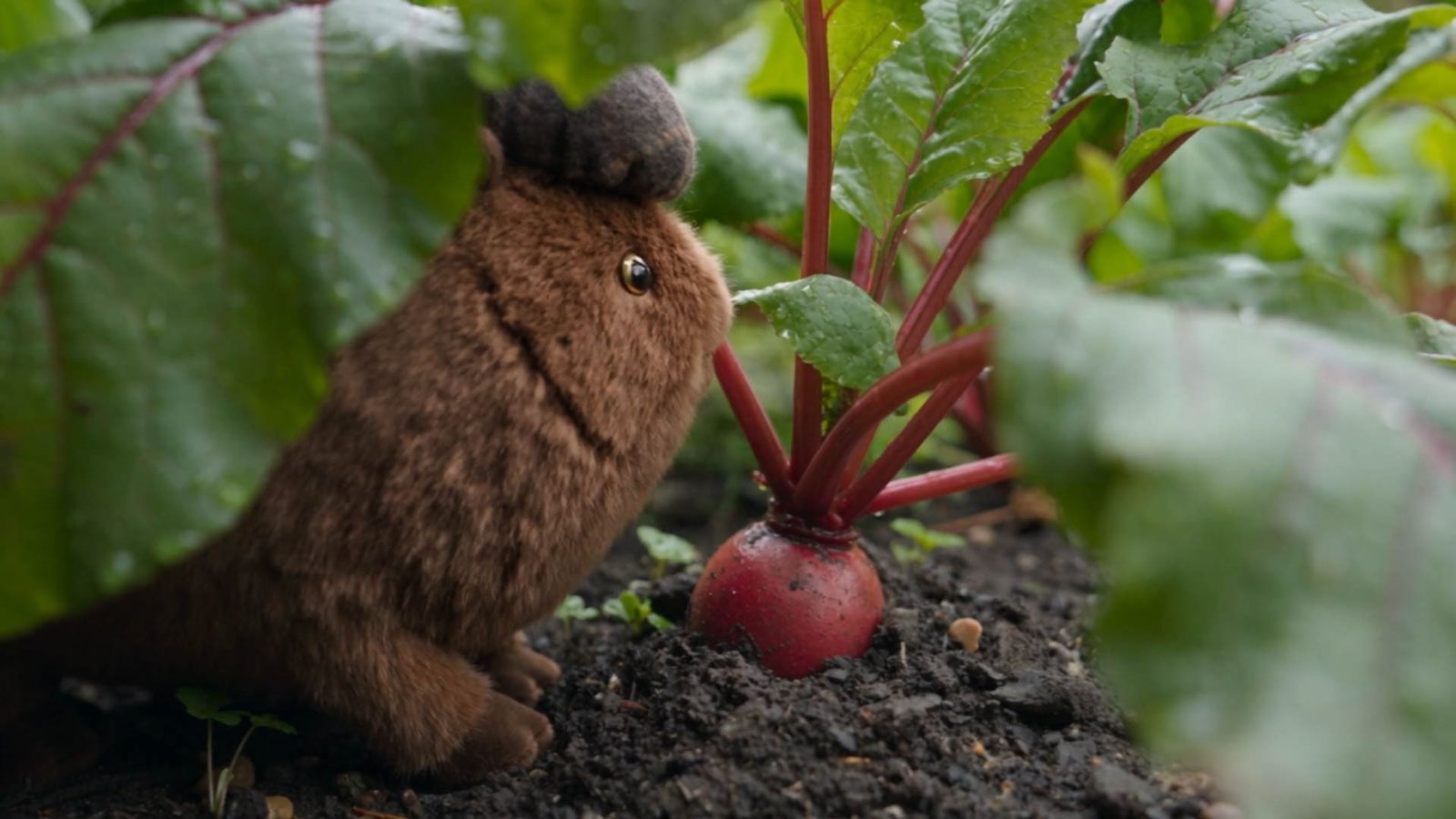
The Garden Haggis appears to forage opportunistically. Its proposed diet includes seeds, fungi, fallen fruit, tender vegetation and small invertebrates, with the relative importance of each likely changing through the year. Feeding takes place close to the ground, where individuals may investigate small areas slowly before moving on. Minor disturbances around moss, borders and the edges of paving may therefore be consistent with its style of foraging, although such signs alone cannot establish the presence of an animal.
Movement without distance
Despite the species' rounded body and short limbs, its proportions should not necessarily be interpreted as evidence of poor mobility. Its apparent strategy is based on short bursts of movement rather than prolonged travel. When disturbed, an individual may retreat rapidly towards vegetation before becoming still. At that point the coat itself becomes part of the defensive response, breaking up the animal's presence against earth, bark and leaf litter.
Stillness matters. In a habitat containing open lawns alongside dense pockets of vegetation, remaining unnoticed can be more useful than attempting a lengthy escape. The Garden Haggis therefore seems particularly suited to moving between nearby refuges, using the complexity of the garden rather than travelling far across it.
Its social organisation is less clearly understood. Most descriptions concern solitary animals, which may indicate that adults occupy individual territories or simply reflect how difficult multiple animals are to observe at once. Encounters between individuals are described as cautious rather than strongly aggressive. Low repetitive sounds have also been associated with Garden Haggises after sunset, though separating a possible haggis vocalisation from the ordinary noises of frogs, birds and other garden wildlife presents an obvious difficulty.
Reproduction and shelter
Reproductive behaviour remains similarly obscure. Sheltered locations beneath shrubs, outbuildings and accumulated vegetation are considered plausible nesting areas. Juveniles are thought to remain concealed during their earliest development, a strategy that would reduce their exposure within a habitat where conditions can change abruptly.
A domestic garden may appear stable, but from the perspective of a small ground-dwelling animal it is not. Vegetation can disappear in a morning. Lawns are cut, leaves removed and previously undisturbed corners cleared. Cats and foxes introduce further pressure. The same human activity that creates the varied habitat occupied by the Garden Haggis may therefore alter or remove it with considerable speed.
A landscape in miniature
The Common Garden Haggis is notable precisely because its world is so restricted in scale. Its ecology is not defined by distant mountain ranges or extensive forests, but by the relationship between a hedge and a lawn, damp soil beneath a shrub, the protection of a stone boundary and the few exposed metres separating one refuge from another. Within that miniature landscape, its compact morphology, subdued colouring and cautious patterns of movement form a coherent set of adaptations.
Much about Haggii s. hortensis remains unresolved. Its social organisation, reproductive cycle and the function of its distinctive cranial structure would all require more systematic observation before firmer conclusions could be drawn. What can be said from the supplied account is that the Garden Haggis is presented as a creature closely associated with the small-scale complexity of Scotland's cultivated environments. To understand it, attention has to shift downwards, towards the narrow, sheltered world at the bottom of the garden.
Your wee garden neighbour
A Scottish adventure. Closer than you think.
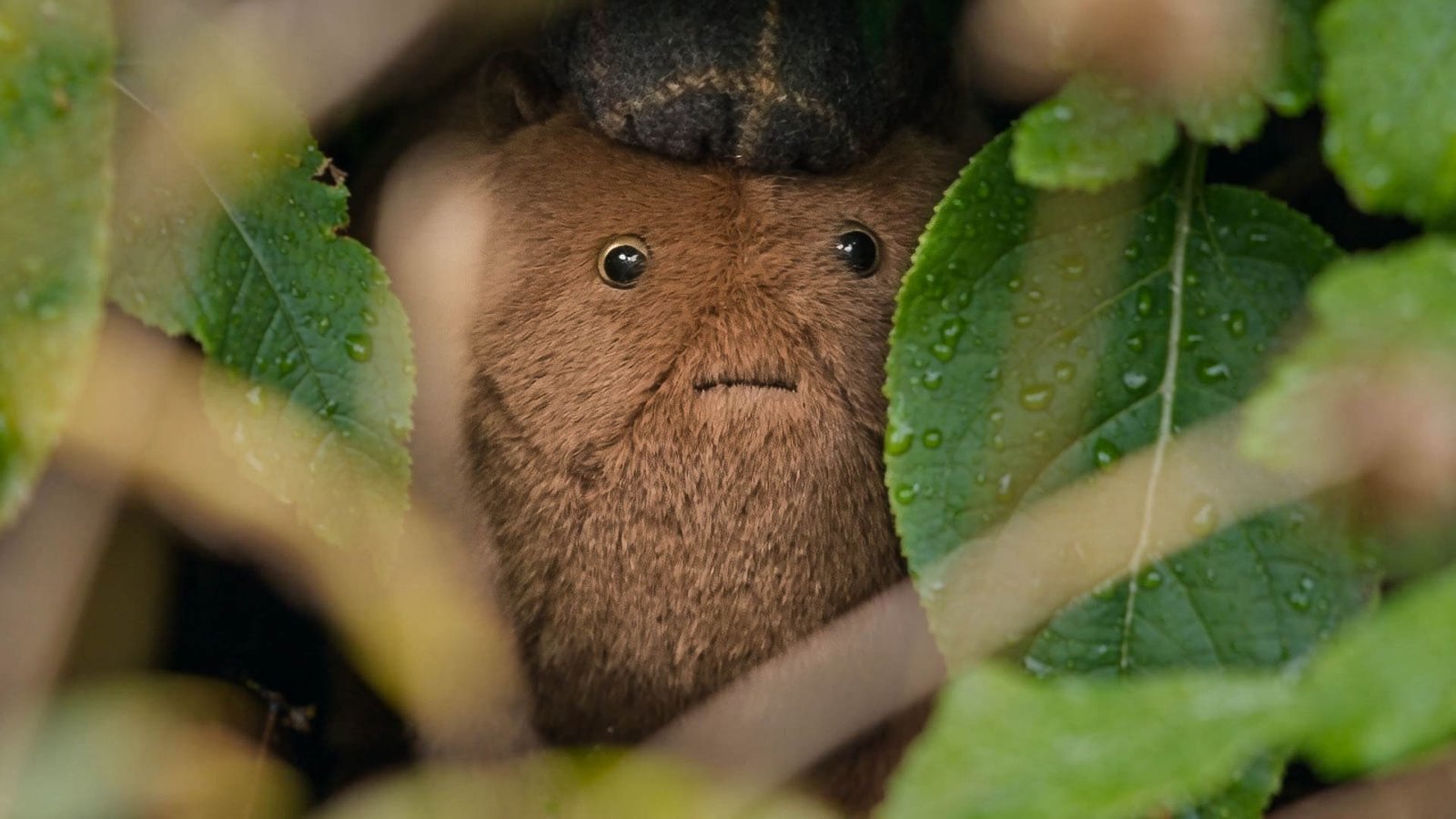
At the quiet edges of a Scottish garden, a small, round neighbour may already be watching. The Common Garden Haggis keeps close to cover, slipping beneath hedges and disappearing around flower beds.
It is the first haggis to look for when your spotting adventures begin. Learn its habits, choose a quiet corner and give it time to show itself.
More about
The Garden Haggis
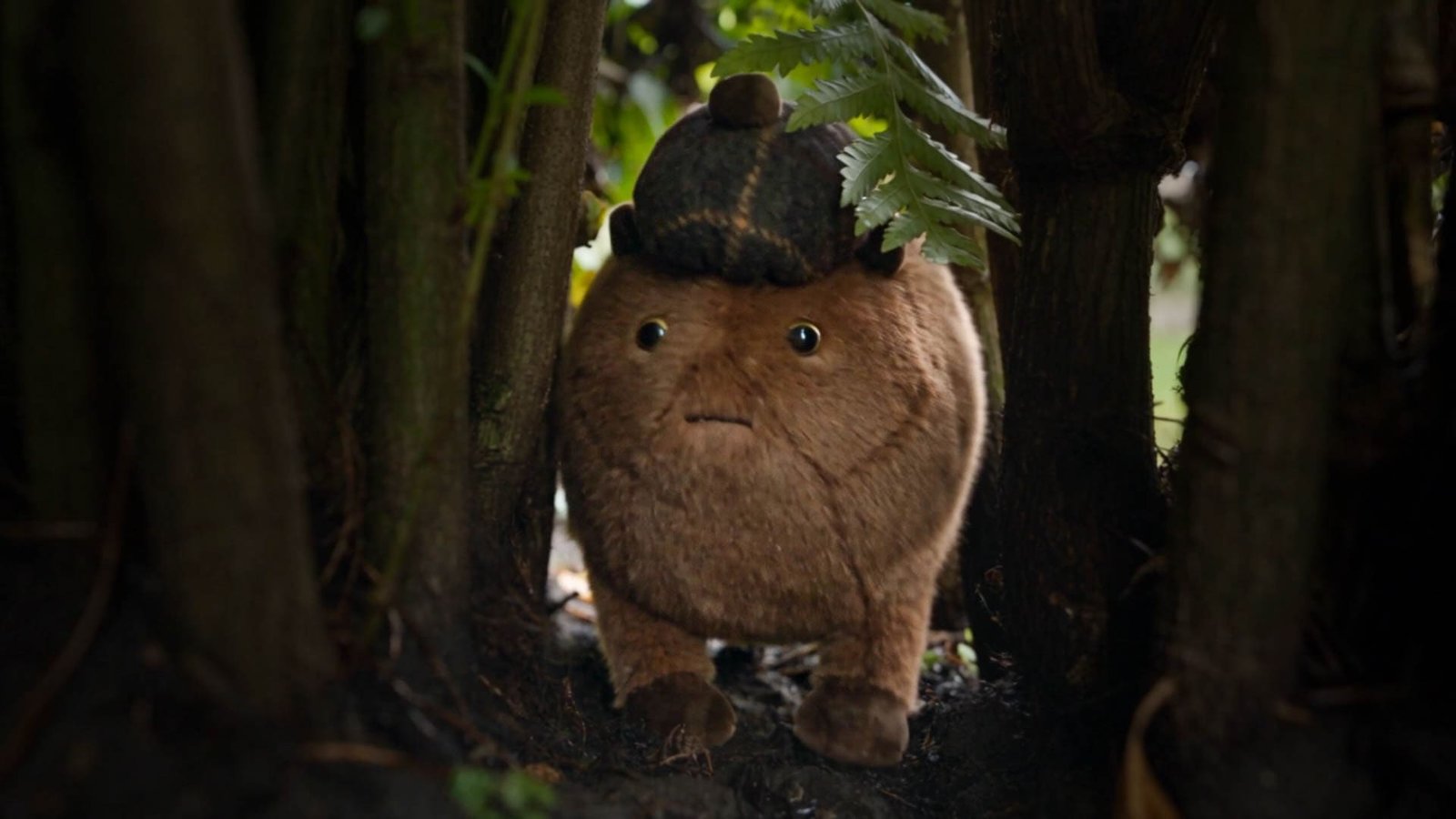
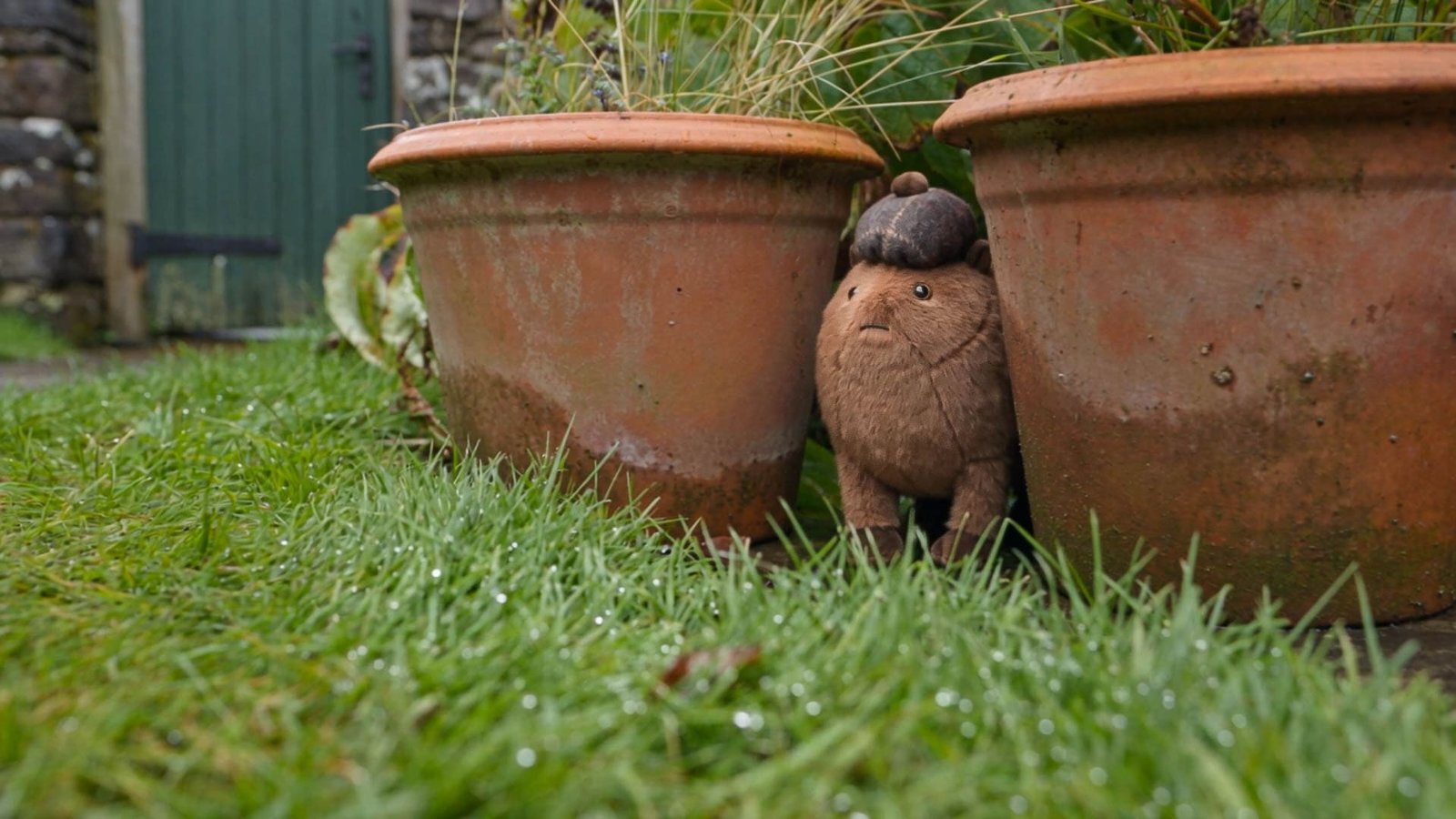
The Common Garden Haggis is a small and curious creature often found wandering through gardens. It has only three legs, which means it can only run comfortably in one direction around the garden. Once it starts going, it tends to keep circling the same way, usually hiding among bushes, flowerpots and garden sheds. Learning how to find your first Garden Haggis is where your journey through Scotland begins!
From the Foundation’s field notes
How to find a Garden Haggis.
Eight small steps towards your first sighting. Take your time. There is plenty to notice.
Begin your search at dusk
Head into the garden as the day grows quiet and the shadows begin to lengthen.
Leave out neeps and tatties
Place a little chopped turnip and potato beside a sheltered hedge.
03 Look for tiny tracks
Check soft soil around the flower beds for the marks of three little feet.
Check the garden edges
Look beneath hedges and among low leaves. A round, brown shape can be easy to miss.
Crouch low and stay silent
Find a comfortable spot a little way back. Let the garden settle around you.
Listen for a rustle
A twitching leaf or a soft shuffle may be your first clue that one is close.
Watch for the sideways scuttle
Three short legs carry it quickly around the garden, circling in one direction.
Let it come into view
Keep still and enjoy the sighting. Give your Garden Haggis room to carry on.
A NOTE FOR NEW SPOTTERS
The best sightings often happen just as you have decided to wait a little longer.

The Garden Haggis
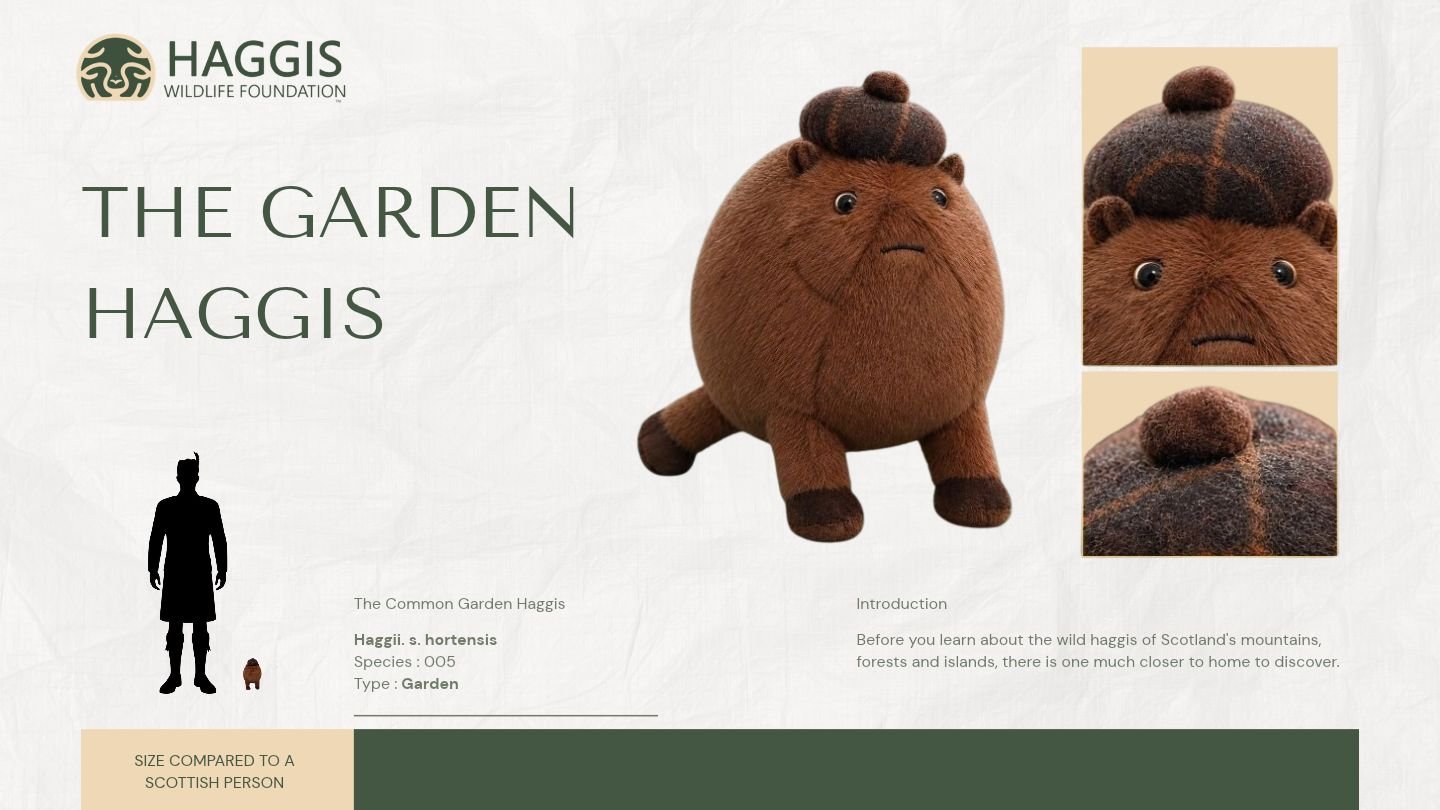
The official Garden Haggis plush toy from the Haggis Wildlife Foundation.
introduces you to your first haggis species, with a book to help you continue learning and exploring. Start with its round shape and three unusual legs, then open the book and begin your adventure. The Common Garden Haggis is only the start. There is a whole world of wild haggis to discover.